Desk review, November 2026
NotebookLM Review 2026: Is It a Lore Tool or a Study Toy?
A source-grounded notebook, judged by what a worldbuilder needs from it. Limits, prices, user reviews and the catch.
Summary
This NotebookLM review is written for worldbuilders, tabletop DMs and indie designers with a pile of lore and no index. NotebookLM, renamed Gemini Notebook in July 2026, answers only from the sources you upload and cites them, which makes it a strong canon checker. The free tier caps you at 50 sources per notebook, paid plans reach 300 or 600, and usage now resets every five hours. Verdict: 7.6 out of 10. It reads your world well, it does not build one, and its audio and video summaries need a human pass.
NotebookLM, now branded Gemini Notebook, is the best free way to interrogate your own lore: answers come only from your uploaded sources, with citations. Plans cap sources at 50 (free) up to 600 (Ultra). It scores 7.6/10: sharp for canon checks, weak as a world generator, and user ratings split from 4.6 on G2 to 2.4 on Trustpilot.
- Source grounding
- 8.5/10
- Worldbuilding fit
- 7/10
- Value for money
- 8/10
- Reliability
- 6.5/10
- Ease of use
- 8.5/10
- Answers cite the exact passage in your own notes, so canon disputes end quickly
- Free tier already holds 50 sources per notebook, enough for most campaign bibles
- Audio Overviews turn a lore dump into a listenable briefing for your players or your co-writer
- Users report outside information leaking into answers despite the source-only promise
- Usage is now a compute budget that refreshes every 5 hours, so heavy sessions hit a wall
- It cannot generate a playable world or new lore with the rigor it checks existing lore
Free plan available. Paid tiers come through Google AI plans.
How this review was built
- Plan paid
- Plans compared from Google's public pages (Free, Plus, Pro, Ultra); no paid trial
- Version tested
- NotebookLM as Gemini Notebook, documentation and plan pages as of 12 November 2026
- Test period
- 2026-11-10 → 2026-11-12
This review is a documentation and reputation analysis, not a hands-on benchmark. Between 10 and 12 November 2026 we read Google's official plan page, the plan and usage-limit help articles and the product FAQ, then cross-checked them against a third-party limits guide dated September 2026. We aggregated public ratings from G2, Trustpilot and Product Hunt and read the recent Trustpilot reviews in full. Reddit threads were read through search excerpts only. Then we judged each finding against one question: would it help someone who keeps a large body of fictional lore and needs to query it? Where we reason about worldbuilding use, we say so, and we label it as our judgement rather than a measurement.
Should you use NotebookLM?
YES if you...
- Game masters and writers who keep lore across dozens of docs and forget what they decided
- Indie teams who need a searchable, citable design bible shared with a co-designer
- Narrative designers who want a spoken recap of a long world document
- Anyone who wants an AI that quotes their notes instead of inventing canon
NO if you...
- Creators who want the AI to invent a playable world from a prompt (that is a different tool category)
- People who need guaranteed source-only answers for legal or compliance work
- Heavy daily users on the free plan who will hit the 5-hour usage reset
- Teams that need offline or self-hosted storage for unreleased IP
What the tiers actually change
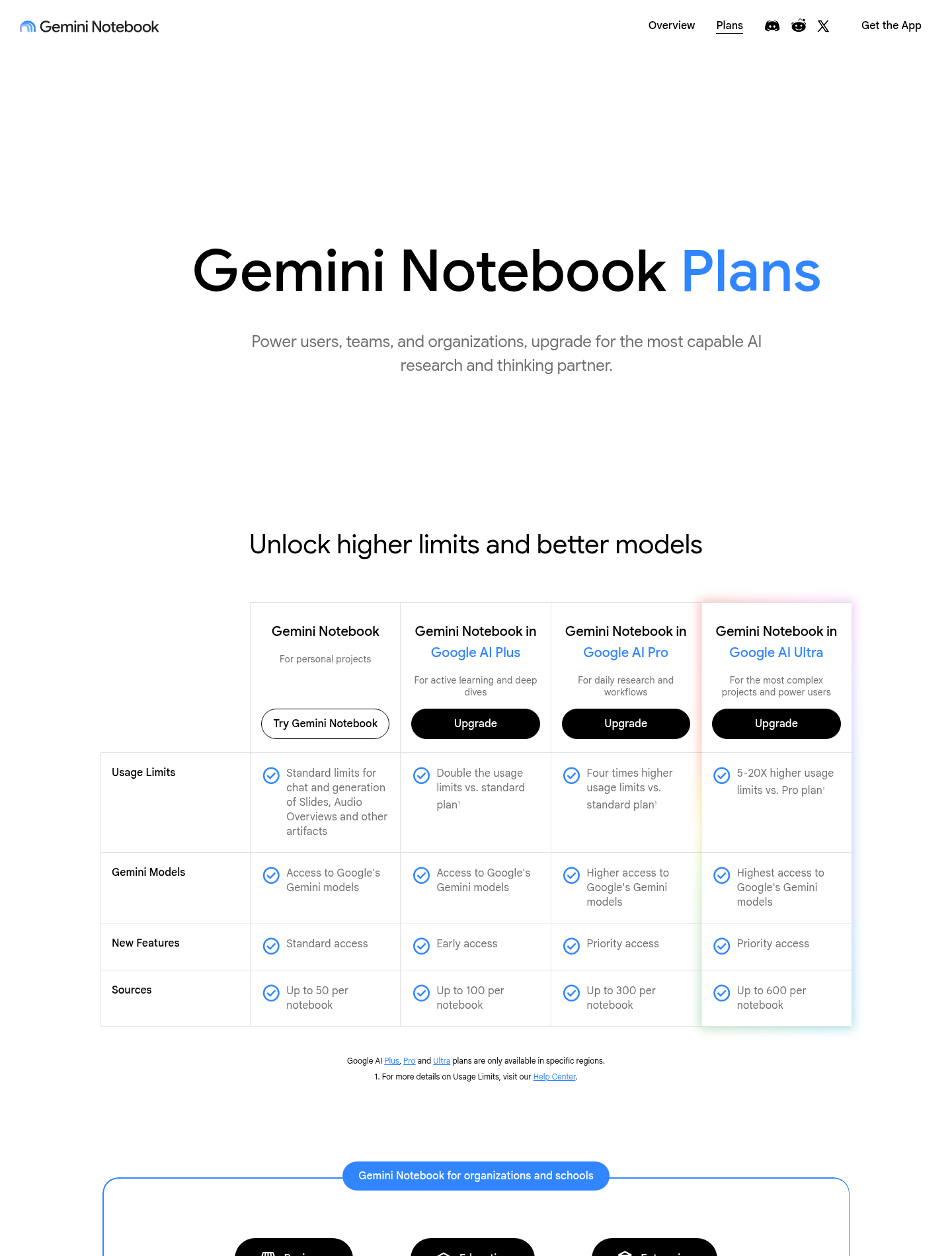
Limits are from Google's plan page. Dollar prices come from third-party 2026 guides and may differ by region, so confirm at checkout.
Free
Standard limits
- 50 sources per notebook
- 100 notebooks per user
- Access to Gemini models
- Standard access to new features
Google AI Plus
2x standard usage
- 100 sources per notebook
- 200 notebooks
- Early access to features
Google AI Pro
4x standard usage
- 300 sources per notebook
- 500 notebooks
- Higher Gemini access
- Visible watermark can be removed
Google AI Ultra
5x to 20x the Pro usage
- 500 or 600 sources per notebook
- 500 notebooks
- Highest Gemini access
ROI breakdown: A 40-document campaign bible fits the free tier. You pay when a world grows past 50 sources or when you generate audio and video every day.
Hidden costs & gotchas
- Plus, Pro and Ultra are bundled with Google AI plans, so you pay for the whole bundle, not NotebookLM alone
- The usage budget is compute-based, so long chats and video generation drain it faster than short questions
- Google AI plans are only sold in specific regions
What the sources show
Sourced figures only. Nothing below is a lab measurement of ours.
- Sources per notebook, free tier
- 50 sources Google plan page, 12 Nov 2026; Plus 100, Pro 300, Ultra up to 600
- Maximum size of one source
- 500,000 words or 200 MB Third-party limits guide, September 2026; the same on every plan
- Usage reset window
- 5 hours Google usage-limits help page; capped by a weekly limit
- Languages supported
- 80+ languages Google Gemini Notebook help overview
- G2 rating
- 4.6 / 5 21 reviews, 85% five-star
- Trustpilot rating
- 2.4 / 5 12 reviews, 11 of them in the last 12 months
Plans page: how far does a world bible fit before you pay?
Pros and cons
Pros
- Answers are anchored to your own text Google describes the product as source-grounded, with in-line citations. For a lore bible that means you can click back to the sentence that settles an argument.
- The free tier is generous for a campaign Fifty sources per notebook and 100 notebooks cost nothing, which covers most settings, session logs and character sheets.
- Many ways to read the same material The product page lists Audio Overviews, Video Overviews, mind maps, reports, flashcards, quizzes, data tables, infographics and slide decks.
- It accepts messy inputs PDFs, websites, YouTube videos, audio files, Google Docs and Slides are all accepted, so scans and session recordings can sit next to wiki exports.
Cons
- Reports of outside information mixing into answers A September 2026 Trustpilot review says answers added material that was never uploaded, and a Reddit thread describes wrong output from a six-page PDF. Treat citations as leads to verify.
- Usage budget is opaque and resets every 5 hours Since September 2026 limits are compute-based rather than fixed counts, so you cannot predict how many questions a session will cost.
- No way to generate new playable content It summarises and questions what you give it. It will not produce a navigable world, level or NPC system.
- Rename and bundling add confusion NotebookLM became Gemini Notebook in July 2026, and paid limits now sit inside Google AI plans, which one user said was confusing after upgrading.
Final verdict
NotebookLM is a reading tool for people who already wrote the world. If your canon lives across a hundred messy files, it gives you a fast, citable way to ask what you decided three sessions ago. That is real value, and the free tier covers it.
It is not a world engine. It will not turn a prompt into a place you can walk through, and the gap between its marketing and its occasional drift off your sources is the reason we stop at 7.6 and not higher. Check every citation that matters before you retcon something.
Our advice: start free, load one setting, and test it on three questions where you already know the answer. If it passes, keep it as your lore index and pair it with a generation tool for the actual building. Pay for Pro only when you pass 50 sources or generate audio every day.
- Source grounding 8.5/10 Citations back to your own files
- Worldbuilding fit 7/10 Great for canon, silent on creation
- Value for money 8/10 Free tier is real
- Reliability 6.5/10 Drift and wrong answers reported
- Ease of use 8.5/10 Upload and ask
Common questions
Is NotebookLM still called NotebookLM?
Is NotebookLM free?
How many sources can one notebook hold?
Does NotebookLM hallucinate?
Can NotebookLM help with worldbuilding or D&D campaigns?
Does Google train on my notebooks?
What happens when I hit the usage limit?
Update log
- Initial publication. Plan limits, usage rules and ratings read on 12 November 2026.