Unity vs Unreal Engine: What a Solo Dev Should Pick
Summary
Unity vs Unreal Engine comes down to fit and cost timing. Pick Unity for 2D, mobile or stylized games made by one to three people: it is free under $200,000 in revenue, then $2,310 per seat yearly. Pick Unreal when photoreal visuals are the pitch and you can handle C++: it is free until $1 million lifetime revenue, then a 5% royalty. Godot is the zero-fee third option.
If you are choosing between Unity vs Unreal Engine for a small game, pick Unity when your game is 2D, mobile, or stylized and you work alone or in a tiny team. Pick Unreal when the look of the game is the pitch and someone on the team can live in C++. Both are free to start. The real difference is when the bill arrives: Unity charges seats once you cross a revenue line, Unreal takes a cut only after your game earns its first million.
That is the short version. The rest of this article is the reasoning, the numbers, and the cases where I would ignore my own advice.
Who am I choosing for?
Most "Unity vs Unreal" posts are written for a studio of forty. You are probably one person with a laptop, a saved folder called world-idea and about six evenings a week.
That changes the question. You are not asking which engine is better. You are asking which one lets you finish. A shipped small game beats an unshipped beautiful one, every time.
Here is the filter I use before comparing a single feature:
How many people will touch the project? One to three points toward Unity. Ten or more points toward whichever engine your senior hire already knows.
What does the player see first? A hand-painted 2D scene or a phone screen points toward Unity. A photoreal forest at golden hour points toward Unreal.
Who writes the code? C# is easier to pick up and easier to debug. C++ gives you more control and punishes every shortcut.
Where will it sell? Mobile leans Unity. Steam and the Epic Games Store are open to both.
Answer those four honestly and you have already made most of the decision.
What does each engine actually cost in 2026?
Money is where most comparisons get sloppy, so let us be exact.
Unity Personal stays free while your revenue and funding stay under $200,000 a year. Above that you move to Unity Pro, which Unity lists at $2,310 per seat per year after the January 2026 increase. The controversial runtime fee is cancelled and does not apply to games made with Unity 6 or earlier versions.
Unreal Engine is free to download and use. Epic takes a 5% royalty on gross revenue above $1 million lifetime, counted per product. Revenue earned through the Epic Games Store is excluded from that calculation, as the licensing breakdown at Nasty Rodent explains.
Put in plain terms:
Unity charges by team size and time. Five people on Pro pay $11,550 a year, whether the game sells ten copies or ten million.
Unreal charges by success. A game that earns $900,000 owes nothing. A game that earns $2 million owes 5% of the last $1 million, which is $50,000.

For a solo dev under the Unity threshold, both engines cost $0 on day one. The difference only appears if the game works. That is a nice problem, and it deserves an actual spreadsheet, not a vibe.
Worth the splurge: Unity Pro once you have a team of three or more and a publisher-sized budget. Skip it if you are alone and under $200k.
Which engine is easier when you are alone?
Unity, and it is not close for the first month.
C# reads like a normal programming language. The editor runs on a mid-range laptop. The 2D tools (Tilemap, sprites, physics) are mature, and almost every question you will ever have has been asked and answered on a forum somewhere.
Unreal asks more of you upfront. Blueprints, its visual scripting system, let a designer build real gameplay without writing code, and that is genuinely good. But the engine wants a strong PC, compile times stretch, and once you drop into C++ you are managing memory and build errors that Unity never shows you.
I distinguish what I have tested from what I have read. The hardware and iteration-time gap is consistent across nearly every indie comparison I found, and it matches what most solo devs report: the slower the loop, the fewer experiments you run per evening. Fewer experiments means a weaker game.
Skip Unreal if your machine is more than four years old and you are not willing to upgrade it. You will spend the savings on waiting.
When does Unreal's look justify the pain?
Unreal earns its place when the screenshot is the marketing.
Lumen lighting, Nanite geometry and the environment tools give a two-person team visuals that used to need a rendering programmer. If you are building a moody walking sim, a photoreal short experience, or anything where a trailer sells the wishlist, that matters.
The scene below is the kind of thing I mean: fog, lanterns, wet stone, a village that feels lived in. You can build it in either engine. Unreal gets you 80% of the way there before you have written a line of gameplay.
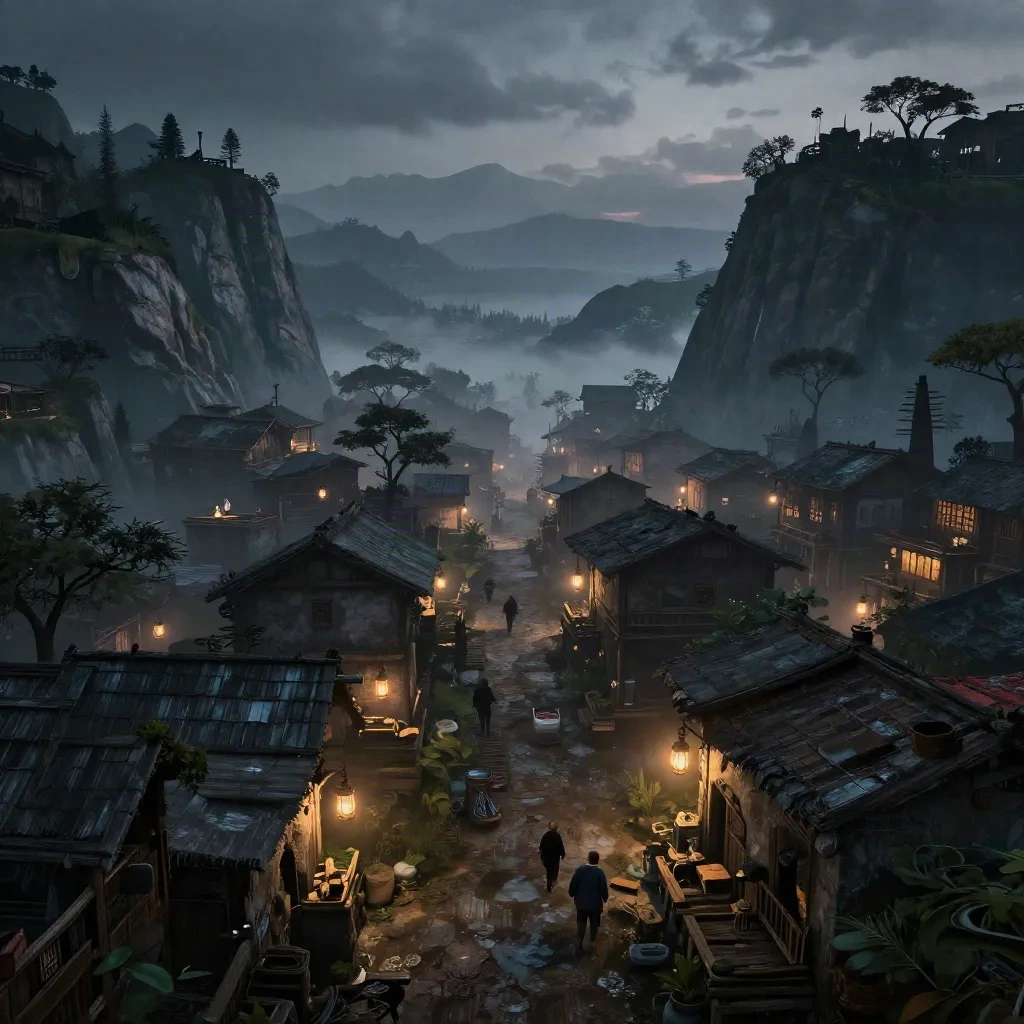
The cost is scope. Photoreal assets are heavy, every mesh needs care, and one artist cannot fill a photoreal world alone. That is where asset packs, scans and generative tools start to pull real weight. A text-to-image tool can cover concept art and texture reference in an afternoon, though you still hand-finish anything the player sees up close.
Worth it if the look is your hook. Not worth it if your game is a clever mechanic in a plain box.
What about hiring, consoles and long-term risk?
Three things that do not show up in a feature list but bite later.
Hiring. Unity developers are easier to find and cheaper to bring on, since C# is a common skill. Unreal specialists cost more, sometimes 30 to 50% more according to indie hiring reports, and good C++ gameplay programmers are scarce. If you plan to contract out even a little, that gap is real money.
Consoles. Both engines ship to PlayStation, Xbox and Switch, but the paperwork is your job either way. Unity has a long track record with small console ports. Unreal handles heavy 3D well, yet hitting a Switch performance budget with an Unreal-scale scene takes serious optimization time.
Trust. Unity's runtime fee episode in 2023 made many devs wary of relying on one vendor's pricing. The fee is cancelled, but the memory lingers. Whichever engine you pick, keep your project in version control, keep your assets portable, and avoid building your whole design around one proprietary feature.
Is Godot the honest third answer?
Sometimes, yes. If you keep reading "Unity vs Unreal" and feel neither one fits, the honest third option is Godot.
It is open source under the MIT license. No royalties, no revenue thresholds, no seat licensing. Scripting is in GDScript or C#, the editor is tiny, and 2D is excellent.
The trade is ecosystem. You will find fewer tutorials, fewer plugins, fewer console pipelines, and fewer contractors who list it on a CV. For a solo dev shipping to PC and web, that trade is often fine. For a team that expects to hire, it is a risk.
I would not tell a 3D-heavy team to switch to Godot mid-project. I would tell a beginner starting a small 2D game to seriously consider it before paying anything anywhere.
Where does AI fit into the engine decision?
It changes the work around the engine more than the engine itself.
Two years ago, the biggest gap between a solo dev and a studio was content volume. Twelve environment tiles, forty props, a hundred lines of dialogue. Generative tools now cover a lot of that first pass: concept art, placeholder textures, code scaffolding, prompt-driven world sketches.
That shifts the engine question in a specific way. If AI can fill your content gap, the engine's job becomes rendering that content well and letting you iterate fast. Both engines can do it. Unreal renders heavy generated assets more gracefully. Unity gets a generated prototype on screen with less friction.
Coding help matters too. An assistant that reads your whole project can write C# gameplay glue, explain a build error, or refactor a messy script. C# has a large public corpus, so the suggestions tend to be more reliable than for Unreal's C++ APIs, which change between versions.
Treat every generated script as a draft. Read it, run it, and keep version control on. The assistant saves hours, not judgment.
So which one should you pick?
Here is what I would actually do, by situation:
Solo, 2D or stylized, budget under $200k: Unity, or Godot if you hate licensing risk.
Solo or duo, photoreal 3D, strong PC, some C++: Unreal. The $1 million royalty line is far away.
Mobile first: Unity. The tooling and market habits are built around it.
Planning to sell on the Epic Games Store: Unreal gets more attractive, since that revenue is excluded from the royalty.
Team of five or more, long production: run the seat math for Unity against your revenue forecast for Unreal, then decide. Neither is universally cheaper.
Then do the boring test. Build the same tiny vertical slice in both: one room, one mechanic, one lit scene. Give each a single weekend. Note where you got stuck, not which screenshot looked better.
The engine that gets you to a playable build first is the right one for now. You can change later, and most of what you learn about design carries over.
Fork it. Change one thing. See what happens.