Character AI Alternatives: 4 Picks for World Builders
Summary
Searching for character ai alternatives usually means one of three things: more memory, fewer limits, or more control. This comparison checks four options against Character.AI's own free and c.ai+ tiers: Janitor AI for the closest free swap, SillyTavern for full ownership, NovelAI for lorebook-driven fiction, and Inworld for shipping a voiced character inside your own game. Prices and limits were checked on each product's own pages in November 2026.
Of the four character ai alternatives compared here, Janitor AI wins as the closest swap for Character.AI: free chats with no message cap, a catalog of community bots, and a paid tier at $12.99 a month. SillyTavern wins on control, NovelAI on long-form lore, and Inworld on shipping a voiced character in your own game. Character.AI still wins on zero-setup polish. Pick by the failure you want to fix, not by the longest feature list.
You opened Character.AI for one scene. Three hours later the character forgot your name, the filter blocked a villain from being a villain, and a full-screen ad sat on top of the best line of the night. That is usually the moment people type "character ai alternatives" into a search bar.
The good news: the field is wider than it was. The honest news: none of the four tools below does everything Character.AI does. Each one trades something specific for something else.
What do you actually want to fix?
Before you pick a tool, name the failure. Most people searching for character ai alternatives have one of four:
The memory failure. The character drifts after a few hundred messages.
The rules failure. The platform refuses scenes your story needs.
The ownership failure. The characters you built live on someone else's server.
The shipping failure. You want a character inside your own game, not inside a chat app.
Janitor AI answers the first two for free. SillyTavern answers the third. NovelAI answers the first with more structure. Inworld answers the fourth. Character.AI answers none of them, and still wins on friction. That last point matters more than critics admit.
Why Character.AI is still the baseline
Character.AI's homepage promises access to 10M+ characters after a ten-second sign-up. That is the product. You do not configure a model, write a card, or pick a backend. You open an app and talk to something.
Its free tier is real but interrupted: ads appear mid-chat and swipe regenerations are capped. The c.ai+ plan costs $9.99 a month or $94.99 a year and adds priority access, unlimited voice calls, enhanced memory and longer character personas. Stories mode gives a narrated, choice-driven format next to open chat.
The limits are what send people searching. Moderation is stricter than the other tools here, and a character you build lives on its platform. For a worldbuilder, that second point is the quiet one. Your cast is not a file you can carry.
Janitor AI: the closest swap
Janitor AI is what you get if you take the Character.AI loop and remove most of the friction. Its homepage claims 15M+ users and a catalog of more than 649,000 characters, with tags for RPG, Game, Scenario and Fictional. Browse the popular shelf and you will find whole guild parties, magic academies and cyberpunk cities set up as playable scenes.
The free tier gives unlimited chats on its built-in model, with a context limit of around 9k tokens. janitor+ costs $12.99 a month, or $8.25 a month on the $99 yearly plan, and adds about five times more context, priority replies, monthly swipes on the best models and access to more models.
The trade-off is quality control. Community bots range from carefully written lorebook systems to three-line prompts. Safety tooling is lighter than at a mainstream platform. Treat it as a library, not a product with an editor.
What the prompt looks like
A good scene bot on any of these platforms starts the same way. Here is a prompt in the style that works across them:
a foggy 1920s Detroit jazz club where the bartender is a robot who remembers every song requested since opening nightPaste that into Janitor AI as a scenario seed, into SillyTavern as a character card description, or into NovelAI as a lorebook entry. It behaves differently in each, which is the whole point of this comparison.
SillyTavern: you own the cast
SillyTavern is not a chatbot. It is a free, locally installed frontend, released under the AGPL-3.0 licence, that talks to text models, image engines and voice models of your choice. It needs NodeJS 20 or higher plus a model backend to do any inference.
What you get for that effort is control. Character cards define behaviour. World Info carries lore and saves tokens on the card. Group chats put several characters in one room, with reply order you can set. Extensions add auto-summary of the chat history, image generation, text-to-speech and web search.
The cost is yours too. A paid API can still produce a bill, and local inference needs capable hardware. The project's own documentation warns that in multi-user mode, chat history and API keys are stored in plain text on the server, so you should not expose it to untrusted users.
If you design games, this is the tool that feels like a dev environment. You can prototype a cast of ten characters, give them shared lore, and move the files wherever you like.
NovelAI: when the world has rules
NovelAI is a storytelling and anime-art platform. Its homepage splits the offer in two: image generation on NovelAI Diffusion V5, and story generation powered by GLM 4.6, with the line "Write worlds that remember everything."
Memory is the reason to pay. Lorebook entries persist facts across a long session, so a faction, a curse or a map stays consistent. Plans run $10 a month for Tablet, $15 for Scroll and $25 for Opus, and there is only a limited trial, 30 image generations, before you pay.
NovelAI is the weakest swap if what you miss is a library of characters to talk to. It is the strongest if what you miss is a story that holds together for months. It does not filter fiction restrictively, which is the main reason writers choose it.
Inworld: not an app, a way to build one
Inworld is the outlier, and it needs a plain description. Today it sells realtime voice models and LLM inference for consumer applications, through an API and a playground. It is not a catalog of characters to chat with, and it is not a game engine.
The pricing page is clear about shape: On-Demand starts at $0 pay as you go, with up to 70 minutes of text-to-speech included. Creator is $25 a month, Builder $100, Developer $300 and Growth $1,500, with custom Enterprise above that. TTS-2 lists at $25 per 1M characters on-demand, and LLM inference starts at $0.07 per 1M input tokens on open models. Every plan includes a commercial licence.
Choose it when the character has to speak inside a build you ship. If you only want to chat, skip it. You would be buying infrastructure to avoid a sign-up form.
How the four compare on memory and control
Memory is where the field splits hardest. Character.AI gives a short free memory and sells longer personas on c.ai+. Janitor AI gives about 9k tokens free and multiplies it on janitor+. SillyTavern gives you World Info and summaries, but the ceiling is whatever model you connect. NovelAI gives lorebooks designed for long fiction. Inworld gives nothing until you build it.
Control follows a similar line. The more a tool does for you, the less you can change. Character.AI sits at one end and SillyTavern at the other, with Janitor AI close to the easy side and NovelAI in the writer's middle.
Which one for which creator?
You run tabletop campaigns. Start with SillyTavern for the cast and NovelAI for the setting lore. Keep Janitor AI as a free sandbox for testing a villain.
You are a solo game designer. Prototype dialogue in SillyTavern, then move to Inworld when a character needs a voice in a build. Expect real integration work.
You stream or write for fun. Janitor AI covers most of what Character.AI did, for free. Pay for janitor+ only if you hit the context wall.
You just want it to work. Stay on Character.AI. Pay the $9.99 if the ads bother you. It is the most polished app here, and polish is a feature.
Fork it. Change one thing. See what happens.
The cheapest test is a single character and a single scene. Write one prompt, run it on two tools, and read what breaks. Where the character drifts, you have found your failure. Where it holds, you have found your tool.
If you need a hint for where to start: take your worst forgotten-name scene from Character.AI, rebuild it on Janitor AI today, and rebuild the same cast in SillyTavern this weekend.
At-a-glance
| Janitor AI | SillyTavern | NovelAI | Inworld AI | |
|---|---|---|---|---|
| Entry price | Free with ~9k context; janitor+ at $12.99/mo or $99/yr | Software is free (AGPL-3.0); model backend billed separately | 30-image free trial; Tablet $10/mo, Scroll $15/mo, Opus $25/mo | On-Demand $0 pay as you go; Creator $25/mo up to Growth $1,500/mo |
| Memory and lore | ~9k tokens free; about 5x more context on janitor+ | World Info lorebooks, auto-summary extension, limits set by your model | Adjustable context plus lorebook entries built for long fiction | You design it: LLM calls are stateless until you add your own memory layer |
| Content rules | Mature content allowed, with an opt-in setting on mobile apps | No policy of its own; depends entirely on the model you connect | No restrictive content filter, the main draw for fiction writers | Your product, your rules, inside the terms of the model provider |
| Setup and platform | Web plus iOS and Android apps, free built-in chat model | Self-hosted on Node.js 20+, no mobile app, you secure it | Web app, subscription required after the trial | API platform with a playground; needs a developer to integrate |
| Fit for game worlds | Large library of RPG and game-world bots, built to be played, not shipped | Character cards and group scenes you can prototype a cast with | Lorebooks for worlds plus anime image generation for concept art | Realtime voice and LLM inference you can wire into a game build |
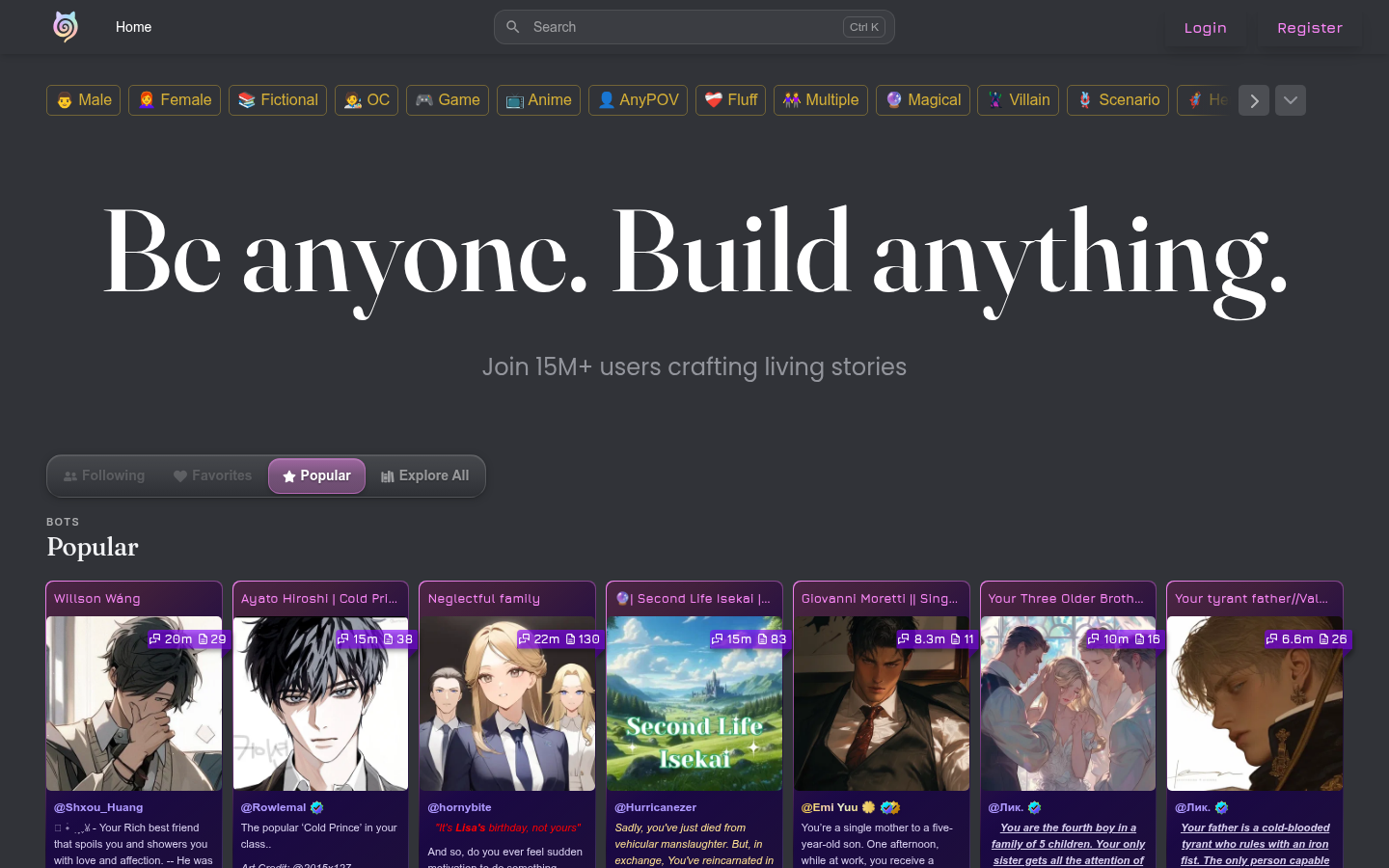
Janitor AI
- Free unlimited chats on the built-in model
- Huge community catalog with many RPG and game-world bots
- Optional jump to a stronger model through janitor+
- Free-tier context is only about 9k tokens
- Bot quality swings wildly from creator to creator
- Moderation and safety tooling is lighter than at mainstream platforms
The closest swap: same chat-with-a-character loop, fewer walls.
SillyTavern
- Free, open-source frontend you run yourself
- World Info lorebooks and multi-character group chats
- Extensions for summaries, image generation and text-to-speech
- You need Node.js 20+ and a model backend before anything works
- Chat history and API keys sit in plain text on your server
- No catalog, no mobile app, no support desk
The workbench for people who want to touch every dial.
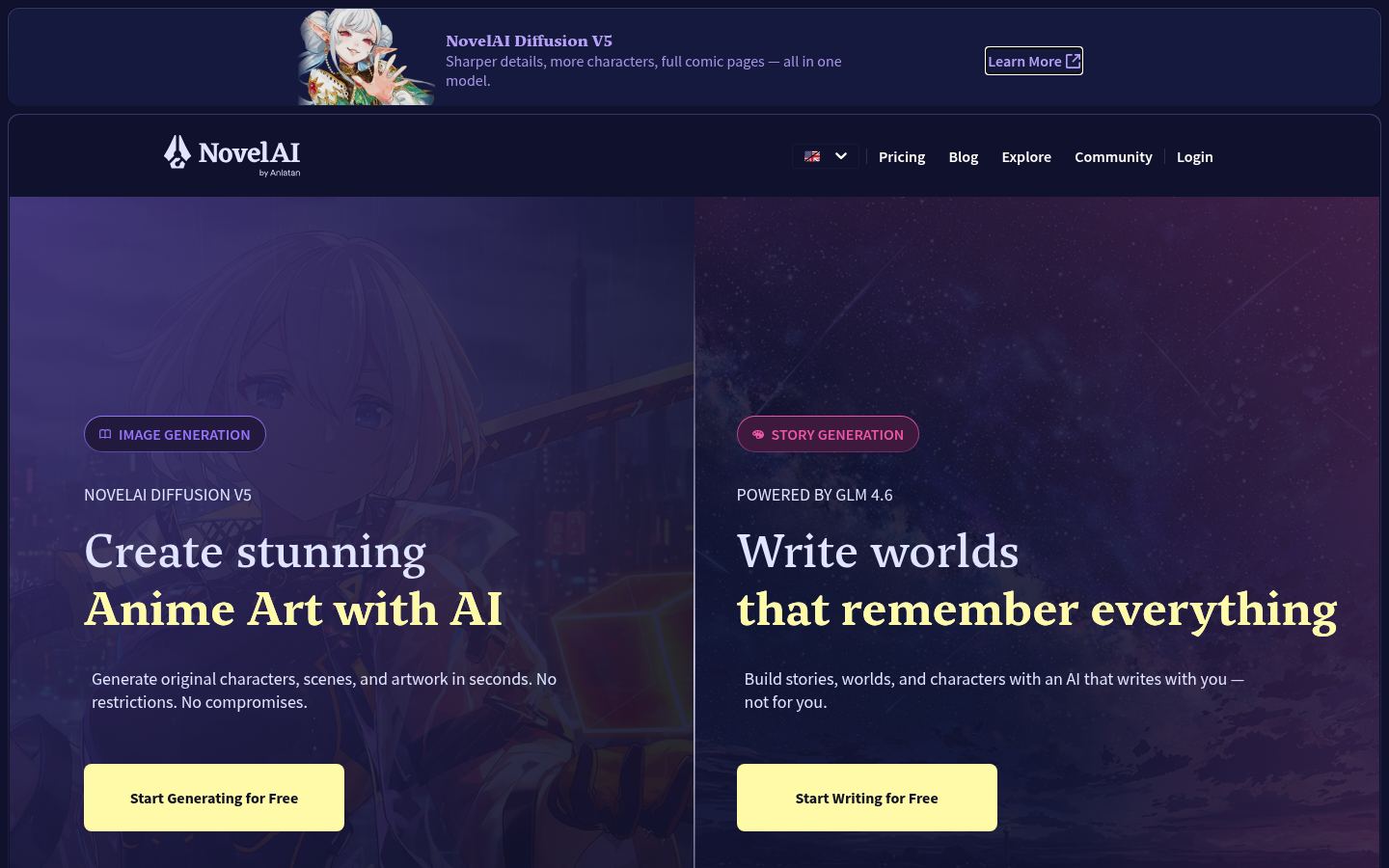
NovelAI
- Lorebook entries keep worlds consistent across long sessions
- No restrictive content filter on fiction
- Anime-style image generation on the same account
- No permanent free tier after the 30-image trial
- Built for writing, not for chatting with a character library
- Best text model is locked behind the $25 Opus tier
Pick it when your world has rules and a history that must not drift.

Inworld AI
- Realtime text-to-speech with voice cloning and voice design
- 100+ LLMs behind one API, open models from $0.07 per 1M tokens
- Commercial licence on every plan, SOC 2 Type II and GDPR
- Infrastructure, not a chat app: there is nothing to play with out of the box
- Needs a developer to wire it into a build
- Costs scale with usage, so budget per session
Not a Character.AI replacement. A way to build your own.
Verdict
Janitor AI is the pick if you simply want Character.AI without the walls. SillyTavern is the pick if you want to own the cast. NovelAI is the pick if your world needs a memory. Inworld is the pick if the character has to live in a build. Stay on Character.AI if friction matters more than control.
How we tested
Every price and limit in this comparison was read from each product's own pages in November 2026: Character.AI's c.ai+ terms, janitor+ at janitorai.com/plus and the Janitor help centre, SillyTavern's documentation, NovelAI's plans, and Inworld's pricing page. Homepage screenshots were captured live on the same day. We rated each tool for a creator who wants characters inside a world, scored 0 to 5 on memory, control, cost and fit for game work. Scores are editorial judgments, not customer-review aggregates. We did not run month-long sessions on every product, so claims about long-run behaviour come from vendor documentation and public user reports and are marked as such. None of these links is an affiliate link.